





MMA training requires athletes to move in several directions within a short period of time. A fighter may switch from a standing position to a deep squat, perform a high kick, defend a takedown, or transition into ground grappling. Conventional shorts with limited elasticity can restrict these movements, create tension around the hips, or pull against the thighs. Four-way stretch fabric helps address these problems by allowing MMA Shorts to extend in both lengthwise and crosswise directions.
For manufacturers and buyers, the value of four-way stretch is not simply that the fabric feels flexible. Its performance depends on how the textile stretches under movement, how quickly it returns to its original shape, and whether it maintains its strength after repeated use. These factors directly influence the comfort, durability, and functional quality of MMA shorts.
How Four-Way Stretch Fabric Improves Movement in MMA Shorts
Four-way stretch fabric provides elasticity in two directions: along the length of the fabric and across its width. This allows the material to accommodate different body movements instead of stretching mainly in one direction.
During a high kick, the hip and thigh areas of MMA shorts experience considerable extension. When an athlete performs a deep squat or changes levels for a takedown, the fabric must adapt to movement around the seat, crotch, and upper legs. During ground grappling, the shorts may also be pulled and compressed as the fighter rotates, bridges, or changes position.
A four-way stretch construction can accommodate these movements more naturally. It reduces the pulling sensation that may occur when fabric reaches its extension limit and helps the garment maintain a more consistent fit throughout training.
For B2B buyers, this makes four-way stretch a valuable specification for MMA training shorts, MMA Grappling Shorts, and MMA Fight Shorts designed for athletes who need unrestricted mobility.
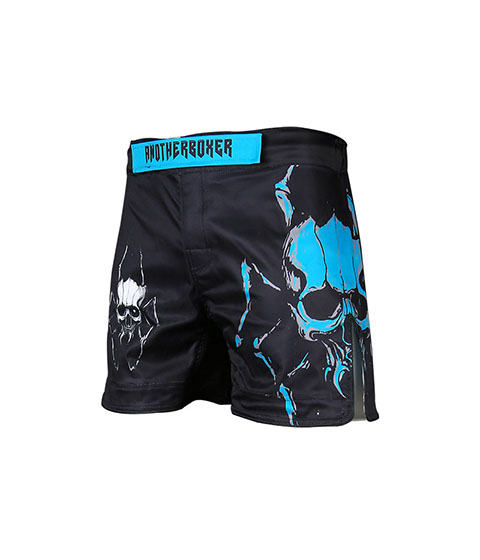
Why Stretch Recovery Matters as Much as Elasticity
High stretch alone does not guarantee good garment performance. A fabric may extend easily but remain elongated after the applied force is removed. This behavior is known as fabric growth, while recovery describes the ability of the material to return toward its original dimensions.
For MMA shorts, poor recovery can cause the seat, waistband, and thigh areas to become loose after repeated training sessions. The garment may gradually lose its original fit, affecting both appearance and wearing stability.
Manufacturers can improve stretch recovery through suitable elastane content, yarn selection, fabric construction, and finishing conditions. However, adding more elastane does not automatically produce a better fabric. Fiber composition, yarn quality, fabric density, and processing parameters must work together.
For example, a manufacturer comparing two stretch fabrics should evaluate both their extension and residual growth after repeated stretching. If one fabric stretches further but retains more deformation, it may not be the better choice for long-term MMA use.
Can Four-Way Stretch Fabric Improve Kicking and Grappling Performance?
Yes. Its main advantage is the ability to accommodate movement across multiple body positions. During kicking, the shorts need sufficient extension around the hip and thigh areas. During grappling, they must adapt to bending, twisting, leg entanglement, and frequent changes in body position.
Consider a training session that combines repeated roundhouse kicks, sprawls, and ground transitions. A fabric with limited crosswise stretch may create tension when the athlete raises or rotates the leg. A fabric with insufficient lengthwise stretch may pull around the seat when the fighter lowers the body. Four-way stretch helps reduce these directional restrictions.
However, fabric elasticity is only one part of garment performance. The crotch gusset, side panels, seam placement, waistband construction, and leg opening also influence mobility. A poorly designed garment can still restrict movement even when its main fabric has excellent stretch properties.
Does Four-Way Stretch Fabric Make MMA Shorts More Comfortable During Long Training Sessions?
It can improve comfort by allowing the garment to move with the athlete instead of resisting every change in position. Reduced fabric tension can help prevent uncomfortable pulling around the waist, hips, and thighs.
Comfort also depends on the fabric surface, weight, breathability, and moisture management. A very elastic but heavy fabric may feel restrictive when saturated with sweat. Similarly, a fabric with a rough surface or poorly finished seams may cause friction during repeated movement.
For this reason, buyers should evaluate four-way stretch together with air permeability, moisture management, fabric hand feel, and garment construction. These characteristics are especially important for MMA combat shorts and MMA Fighting Shorts intended for intensive daily training.
How Is Four-Way Stretch Fabric Developed for MMA Shorts?
The manufacturing process starts with fiber and yarn selection. Polyester is widely used in performance apparel because it offers relatively low moisture absorption, dimensional stability, and practical durability. Elastane can be incorporated to provide additional elasticity and recovery.
The exact fiber ratio depends on the intended fabric weight, stretch target, surface appearance, and garment design. A lightweight fabric intended for flexible training shorts may require a different construction from a heavier fabric designed for frequent contact and abrasion.
After yarn preparation, the fabric is produced through an appropriate knitting or weaving process. Knitted constructions can provide inherent flexibility through their loop structure, while woven stretch fabrics can combine a more stable construction with elastic yarns. The manufacturer must select a construction that balances mobility, stability, and resistance to deformation.
Dyeing and finishing also influence final performance. Excessive heat during processing may affect elastic recovery, while inconsistent finishing can create variations in width, weight, and hand feel. Production controls should therefore monitor fabric tension, temperature, dimensional stability, and color consistency.
What Quality Tests Should Buyers Request for Four-Way Stretch MMA Shorts?
Buyers should request measurable test results instead of relying only on descriptions such as high elasticity or premium stretch fabric.
Stretch and recovery: Evaluate extension and the fabric's ability to return after a specified load and relaxation period. ASTM D2594 is relevant to knitted fabrics with low-power stretch, while other methods may be more suitable for different constructions.
Dimensional stability: Check whether the fabric changes in length or width after washing and drying. This helps identify shrinkage or unwanted growth.
Abrasion resistance: Assess surface wear under repeated friction, particularly for shorts intended for frequent training and contact with mats.
Seam strength and stretch: Test whether seams can withstand movement without opening, breaking, or creating uncomfortable pressure points.
Colorfastness: Check resistance to color transfer from rubbing and color change after laundering, especially for dark or highly saturated colors.
For example, a buyer can request a comparative test of two fabric samples using the same extension, holding time, and recovery conditions. Recording the original dimensions, extended dimensions, and residual growth provides a more useful comparison than simply stretching the fabric by hand.
What Should B2B Buyers Consider When Sourcing Four-Way Stretch MMA Shorts?
When evaluating an MMA shorts manufacturer, buyers should confirm that the fabric specification matches the intended application. Training shorts may prioritize repeated washing, comfort, and everyday durability, while MMA competition shorts may require a closer fit, controlled leg openings, and construction details that meet the buyer's competition requirements.
It is also important to confirm whether the supplier can maintain consistent stretch performance across different production batches. Fabric composition, weight, stretch direction, recovery, color, and shrinkage should be included in the approved sample specification.
For private-label and OEM projects, buyers should also review customization capabilities, including fabric selection, sublimation printing, logo placement, waistband design, drawcord construction, and size grading. A reliable supplier should be able to explain how these choices affect the final garment rather than simply offering different colors and patterns.
Conclusion
Four-way stretch fabric improves MMA shorts performance by accommodating movement in both lengthwise and crosswise directions. It supports kicking, squatting, takedowns, and grappling while helping reduce unnecessary fabric tension. However, stretch and recovery must work together. Fabric construction, seam engineering, moisture management, and dimensional stability are equally important to the final product.
For overseas wholesalers, importers, and sportswear brands, selecting an MMA shorts supplier should involve more than checking the fabric composition. Reviewing test results, approved samples, production consistency, and customization capabilities helps ensure that the finished mixed martial arts shorts meet the demands of real training environments.