





What Are the Different Types of Fishing Clothes?
Fishing clothes generally include Fishing Shirts, pants, shorts, jackets, bibs, vests, waders, hoodies, gloves, and sun-protection accessories. The right Fishing Wear depends on water conditions, weather, fishing method, exposure to sunlight, and the level of protection required. For example, lightweight UPF-rated shirts are suitable for hot-weather fishing, while waterproof jackets and insulated layers are more appropriate for cold or wet environments. For professional users and B2B buyers, selecting Fishing Apparel requires more than appearance: fabric construction, water resistance, breathability, drying performance, abrasion resistance, and garment construction all affect practical performance.
1. Fishing Shirts
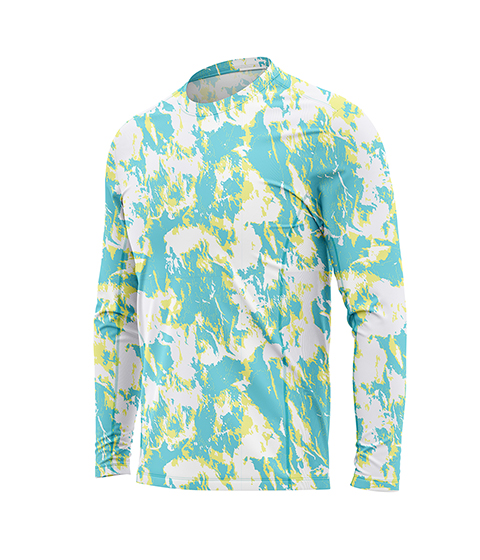
Fishing shirts are among the most widely used types of Fishing Clothing, particularly in warm and humid environments. They are commonly designed with long sleeves, ventilation panels, chest pockets, tool loops, and sun-protection features. Many technical fishing shirts use polyester or nylon fabrics because these materials provide a useful balance of low weight, durability, moisture management, and drying speed.
Long-sleeve fishing shirts are particularly useful for anglers who spend several hours under direct sunlight. A fabric with a UPF 30 or UPF 50+ rating can reduce ultraviolet radiation reaching the skin when the garment is correctly constructed and worn. Mesh panels may also be incorporated under the arms or across the back to improve air circulation.
For B2B buyers, it is important to distinguish between a fabric that is inherently UV-resistant and one that receives a UV-protective finish. Polyester and tightly woven fabrics can provide a physical barrier to UV radiation, while some manufacturers additionally use UV stabilizers or specialized finishing processes. Product specifications should state the applicable test standard rather than relying only on general terms such as “sun protection.”
2. Fishing Pants and Shorts
Fishing pants and shorts are designed to provide mobility while protecting the legs from sunlight, vegetation, insects, hooks, and occasional abrasion. Lightweight polyester, nylon, and blended fabrics are frequently used for warm-weather applications.
Technical fishing pants may include articulated knees, gusseted crotches, reinforced seat areas, adjustable waistbands, cargo pockets, and quick-drying construction. These details are important because fishing often involves repeated bending, kneeling, climbing onto boats, or moving between different fishing positions.
Fishing shorts are more suitable for warm conditions where maximum ventilation is preferred. However, they provide less protection from UV exposure, insects, brush, and cold water than full-length pants. Buyers targeting tropical or coastal markets may therefore need to offer both short- and long-leg options within the same Fishing Outfit range.
3. Fishing Jackets and Rain Gear
Fishing jackets are designed for environments where wind, rain, spray, or low temperatures can significantly affect comfort and safety. Their performance depends heavily on the construction of the outer fabric and seams.
Water-resistant fishing jackets may use durable water-repellent (DWR) finishes that cause water to bead on the fabric surface. Waterproof garments require a more complete moisture barrier, typically achieved through a coated or laminated membrane. Common waterproof construction methods include polyurethane (PU) coatings, TPU films, and microporous or monolithic membrane systems.
Seam construction is equally important. A waterproof fabric can still allow water penetration through needle holes if seams are not properly sealed. For higher-protection Fishing Wear, manufacturers may use seam tape, waterproof zippers, storm flaps, adjustable cuffs, and bonded construction.
Breathability should also be considered. A garment with high water resistance but poor moisture-vapor transmission can cause condensation and discomfort during active fishing. Buyers should therefore evaluate waterproof rating and breathability together instead of selecting a jacket based on water resistance alone.
4. Fishing Bibs and Bib Pants
Fishing bibs provide greater coverage than conventional trousers and are commonly used for boat fishing, offshore fishing, commercial fishing, and wet-weather applications. A bib-style construction extends protection from the legs to the chest, helping reduce water entry when the wearer is exposed to spray or heavy rain.
Heavy-duty fishing bibs often use coated polyester, coated nylon, or waterproof laminated textiles. Reinforced panels may be added at high-wear areas such as the knees, seat, and lower legs. Adjustable suspenders allow the garment to accommodate different body shapes and clothing layers.
For commercial or professional applications, durability and repairability can be more important than minimum garment weight. Buyers should examine fabric thickness, coating adhesion, seam strength, zipper construction, and abrasion resistance when comparing suppliers.
5. Fishing Waders
Fishing waders are specialized Fishing Clothes designed to keep the wearer dry while standing or moving through water. They are commonly used for fly fishing, river fishing, surf fishing, and other applications where anglers need to enter shallow water.
Waders are generally manufactured from neoprene or waterproof breathable textile systems. Neoprene waders provide thermal insulation because the foam structure helps reduce heat loss. Breathable fabric waders, on the other hand, are generally lighter and can be more comfortable during active fishing in moderate temperatures.
Wader design can include integrated boots, stocking feet, gravel guards, reinforced knees, chest pockets, and adjustable suspenders. The correct material depends on water temperature, walking requirements, expected abrasion, and seasonal use.
6. Fishing Vests and Utility Layers
Fishing vests focus on equipment organization rather than weather protection alone. They can provide quick access to hooks, line, lures, pliers, small tackle boxes, and other fishing accessories.
Fly fishing vests are often equipped with multiple front pockets and attachment points. Modern designs may combine lightweight mesh with synthetic woven fabrics to reduce overall weight while maintaining sufficient load-bearing capability.
For professional Fishing Apparel programs, pocket placement should be considered from an ergonomic perspective. Frequently used tools should be accessible without excessive torso rotation or movement. Reinforcement around attachment points is also useful when pockets or loops regularly carry metal tools.
7. Hoodies, Base Layers, and Thermal Fishing Wear
Cold-weather fishing requires a layered clothing system rather than relying on a single thick garment. A typical system consists of a moisture-managing base layer, an insulating mid-layer, and an outer shell that protects against wind and precipitation.
Polyester and merino wool are common base-layer materials. Polyester dries quickly and is suitable for users who require rapid moisture management, while merino wool provides good thermal regulation and odor-control characteristics. Fleece made from polyester is commonly used as a mid-layer because its raised structure can retain warm air while remaining relatively lightweight.
Fishing Hoodies can function as an intermediate layer or sun-protection garment depending on their fabric weight and construction. Lightweight hooded shirts with UPF protection are particularly suitable for warm-weather applications where users want additional coverage without wearing a waterproof jacket.
8. Fishing Accessories and Protective Gear
Fishing Gear Clothing also includes accessories such as fishing gloves, hats, caps, neck gaiters, and waterproof storage garments. These products can address specific exposure problems that conventional clothing cannot fully solve.
Fishing gloves may use synthetic leather, nylon, polyester, neoprene, or stretch fabrics depending on whether the priority is grip, dexterity, abrasion protection, insulation, or water resistance. Hats and caps can reduce direct solar exposure around the face and neck, while neck gaiters can provide additional UV and wind protection.
9. How to Choose the Right Fishing Wear
The correct Fishing Wear should be selected according to the operating environment rather than simply by garment category. B2B buyers should consider several technical factors before placing an order.
Weather and Water Conditions
Hot and sunny environments generally require lightweight, breathable, quick-drying fabrics with appropriate UPF performance. Wet and windy environments require waterproof or water-resistant outer layers. Cold-water fishing requires insulation in addition to moisture protection.
Fishing Method
Fly fishing may prioritize mobility, breathable layers, and waders. Offshore fishing often requires windproof and waterproof outerwear. Tournament anglers may prioritize lightweight shirts with UV protection and rapid moisture management, while commercial users may require heavier fabrics and reinforced construction.
Fabric and Construction
Polyester is widely used for lightweight shirts because it offers good moisture management and dimensional stability. Nylon generally provides strong abrasion resistance and can be useful in demanding outdoor applications. Elastane can be added to improve stretch and mobility, although excessive elastane content may affect heat resistance and long-term dimensional stability.
Buyers should also evaluate GSM, fabric weave, stretch percentage, water-repellent finish, UPF rating, colorfastness, seam strength, zipper quality, and dimensional stability after washing. These specifications provide a more useful basis for supplier comparison than appearance alone.
10. Common Problems When Selecting Fishing Clothing
One common mistake is choosing a fabric that is too heavy for the intended climate. Heavy fabric may provide durability but can increase heat retention and reduce comfort during active fishing. Another issue is assuming that “water-resistant” means completely waterproof. These terms describe different levels of protection and should be clearly defined in product specifications.
Another consideration is fabric compatibility with the intended finishing process. Water-repellent treatments, printing, lamination, seam sealing, and washing processes can affect fabric performance. For private-label and OEM programs, buyers should request pre-production samples and verify key performance requirements before approving bulk production.
Fit is also important. Fishing garments need sufficient ease for casting, reaching, bending, and wearing multiple layers. A garment that is technically protective but restricts shoulder or arm movement may perform poorly in real-world use.
11. Manufacturing Considerations for B2B Buyers
For importers, distributors, and outdoor brands, Fishing Clothing should be evaluated as a complete product system. The manufacturing process typically includes fabric selection, pattern development, cutting, sewing, finishing, quality inspection, and packaging. Technical garments may require additional operations such as seam taping, waterproof zipper installation, heat transfer printing, embroidery, or garment washing.
Quality control should cover fabric weight, color consistency, dimensional measurements, stitching quality, seam strength, zipper operation, print adhesion, and finishing performance. For waterproof products, hydrostatic pressure and seam leakage testing can be useful. For sun-protection garments, buyers should request documentation for the claimed UPF rating and the relevant testing method.
For OEM or private-label programs, technical drawings, measurement charts, fabric specifications, color standards, labeling requirements, packaging instructions, and inspection criteria should be confirmed before mass production. This reduces inconsistencies between samples and bulk orders and makes supplier performance easier to evaluate.
12. FAQ About Fishing Wear
What is the best material for Fishing Wear?
There is no single best material for every fishing environment. Polyester is widely used for lightweight, quick-drying shirts, while nylon is useful when abrasion resistance is important. Neoprene is suitable for thermal protection in waders, while laminated waterproof fabrics are better suited to wet-weather shells.
Are fishing shirts waterproof?
Most fishing shirts are not designed to be fully waterproof. They typically focus on breathability, quick drying, moisture management, and UV protection. Waterproof protection normally comes from a dedicated fishing jacket, shell, or bib.
Why do many fishing clothes have long sleeves?
Long sleeves provide additional coverage against ultraviolet radiation, insects, wind, vegetation, and minor abrasion. When combined with an appropriate UPF-rated fabric, they can be particularly useful during extended outdoor exposure.
What should I wear for fishing in hot weather?
A lightweight long-sleeve fishing shirt, breathable fishing pants or shorts, sun-protection hat, and moisture-managing base layer are practical choices. In very humid conditions, quick-drying fabrics and ventilation panels can improve comfort.
What should B2B buyers check when sourcing Fishing Apparel?
Key factors include fabric composition, GSM, UPF rating, water resistance, breathability, colorfastness, seam construction, size consistency, wash performance, available customization, production capacity, and quality-control procedures. Buyers should also confirm whether performance claims are supported by relevant test reports.
Conclusion
Different types of Fishing Wear serve different environmental and operational requirements. Fishing shirts and lightweight pants are suitable for warm-weather use, while jackets, bibs, and waders provide additional protection against rain, spray, wind, and cold water. Vests improve equipment accessibility, while base layers and thermal garments support cold-weather layering.
For overseas importers, professional fishing brands, distributors, and outdoor equipment companies, the best Fishing Outfit is not simply the one with the most features. Fabric selection, garment construction, weather protection, mobility, durability, and intended fishing conditions should work together. A clear understanding of these technical factors allows buyers to select Fishing Clothing that is appropriate for its market and practical application while establishing more consistent specifications for OEM, ODM, and private-label production.