





For swimwear brands, sporting goods distributors, and apparel importers, understanding the difference between a Rash Guard and a swim shirt is essential when selecting products for different customer groups. Although both garments are designed for water-based activities and may provide UV protection, they differ in fabric construction, fit, stretch performance, intended use, and manufacturing requirements. These differences affect product positioning, sourcing decisions, quality control, and long-term wear performance.
A rash guard is generally designed as a close-fitting performance garment that protects the skin against abrasion, sun exposure, and irritation during surfing, swimming, and other active water sports. A swim shirt, by comparison, is often a looser-fitting garment intended primarily for sun protection during swimming, beach activities, and recreational use. However, the distinction is not absolute: some swim shirts are designed for athletic performance, while certain rash guards offer relaxed fits for casual wear.
For buyers sourcing custom rash guards or developing private-label swimwear collections, the most reliable way to distinguish these products is to evaluate their intended function, textile engineering, pattern design, and verified performance specifications rather than relying on product names alone.
1. Fit and Construction: The Most Visible Difference
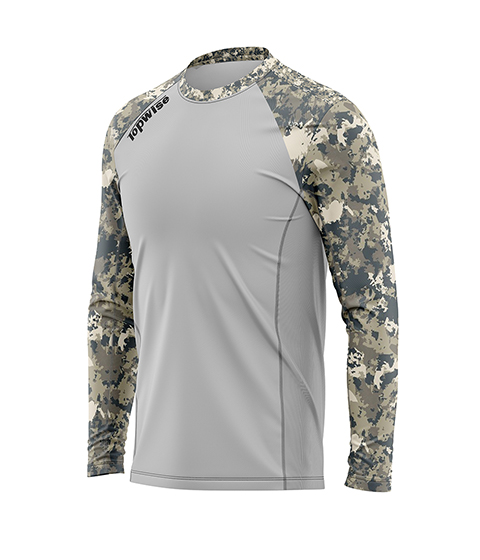
The primary difference between a rash guard and a swim shirt is usually the fit. A rash guard typically fits close to the body, reducing excess fabric movement and helping the garment remain in place during paddling, surfing, snorkeling, and repeated swimming movements. A swim shirt generally allows more room through the chest, waist, and sleeves, making it suitable for consumers who prioritize comfort and easy layering.
This difference begins during pattern development. Rash guard patterns must account for fabric stretch, body movement, and recovery after repeated extension. If the pattern is too tight or the fabric offers insufficient elasticity, seams may experience excessive tension around the shoulders, underarms, and neckline. If the pattern is too loose, the garment may bunch up or create drag in the water.
Swim shirts require a different balance. A relaxed silhouette must provide adequate movement without creating excessive fabric volume that becomes uncomfortable when wet. Buyers should evaluate finished garment measurements against the intended fit category instead of assuming that a standard size chart will work for both products.
For manufacturers producing personalized rash guards, grading is particularly important. Each size must maintain the intended fit, sleeve proportion, and body coverage. A design that fits correctly in a medium sample may become too restrictive in larger sizes if the grading rules do not account for fabric stretch and body proportions.
2. Fabric Engineering: Stretch, Weight, and Water Performance
Fabric selection directly affects the difference between a performance-oriented rash guard and a recreational swim shirt. Many rash guards use nylon-spandex or polyester-spandex blends. Nylon-based fabrics are often selected for their soft hand feel and stretch characteristics, while polyester-based fabrics can offer useful color retention and resistance to certain forms of degradation when appropriately engineered. Actual performance depends on fiber quality, yarn construction, fabric density, dyeing, and finishing.
Swim shirts may use similar synthetic blends, but some prioritize lightweight comfort, a softer surface, or a relaxed drape over compression and close-body recovery. Therefore, the fiber composition alone does not determine whether a garment functions as a rash guard or a swim shirt.
During knitting, yarn tension, stitch structure, machine settings, and fabric density influence elasticity, dimensional stability, and surface uniformity. Inconsistent tension can create uneven stretch across the fabric width, resulting in twisted panels or mismatched garment measurements. Excessive fabric tension during processing may also affect dimensional stability after relaxation or washing.
Heat setting and other finishing operations must be controlled according to the fabric specification. Insufficient stabilization can contribute to shrinkage or shape changes, while inappropriate temperature or processing conditions may damage elastane and reduce recovery. Buyers evaluating an OEM rash guard program should request fabric specifications and test results for stretch, recovery, dimensional change, colorfastness, and resistance to pilling where relevant.
Water performance also matters. A fabric that feels lightweight when dry may become heavier or less comfortable when wet, depending on its construction and finishing. Sampling should therefore include wet-use evaluation rather than relying exclusively on dry fabric hand feel.
3. UV Protection: Why Product Claims Must Be Verified
Both rash guards and swim shirts can be designed to provide ultraviolet protection, but their protective performance should not be inferred from the product category or fabric color. The level of protection depends on fabric construction, fiber properties, dyes, finishing treatments, coverage, and how the material behaves when stretched or wet.
Ultraviolet protection factor (UPF) measures how effectively a textile reduces ultraviolet radiation transmission under specified test conditions. A garment marketed as UPF 50, for example, should be supported by suitable testing rather than an unverified supplier statement. Buyers should also confirm which standard and testing conditions were used, because results may vary with moisture, stretch, and fabric condition.
For close-fitting rash guards, testing only an unstretched fabric swatch may not fully represent the finished garment if the material becomes significantly thinner when worn. Swim shirts also require attention to coverage around the shoulders, upper arms, neckline, and torso. A high-performing fabric cannot protect skin that remains uncovered.
Quality assurance should include reviewing the laboratory report, matching the tested fabric to the actual production lot, and confirming that any claimed performance remains consistent after the specified care process. If a product includes chemical UV-protective treatments, buyers should assess treatment durability and relevant chemical compliance requirements.
4. Sewing and Seam Engineering: Preventing Failure During Movement
Seam construction is another major distinction in performance requirements. Rash guards must withstand repeated stretching during paddling, overhead arm movement, and swimming. Flatlock seams are commonly used in performance garments because they can reduce bulky seam allowances and help minimize skin irritation. However, flatlock construction is not automatically superior in every application; the appropriate seam depends on fabric thickness, garment design, required strength, and production capability.
Overlock seams, coverstitching, and other stretch-compatible constructions may also be appropriate. The critical requirement is that the seam can extend with the fabric without breaking stitches, opening, or creating uncomfortable ridges. Thread selection, stitch density, needle type, machine tension, and operator consistency all affect the result.
Excessive thread tension may cause seam puckering or restrict garment stretch. Insufficient tension can produce loose loops, unstable seams, or poor stitch formation. Incorrect needle selection can damage fine knitted fabrics, creating small holes that may enlarge under repeated strain.
Swim shirts with a relaxed fit may experience lower garment tension during ordinary movement, but they still require durable seams because wet fabric can be heavier and repeated dressing, washing, and pulling can stress high-load areas.
For custom printed rash guards, sewing quality must be evaluated alongside print placement. Panels may be printed before assembly, so registration marks and cutting accuracy are important for matching graphics across seams. Buyers should inspect underarm seams, shoulder joins, sleeve hems, neckline attachments, and other areas likely to experience repeated movement.
5. Printing and Customization: What B2B Buyers Should Evaluate
Customization is a major sourcing consideration for sportswear brands, teams, surf schools, resorts, and promotional merchandise distributors. Both rash guards and swim shirts can incorporate logos, all-over graphics, sponsor branding, and custom colors. Nevertheless, the selected printing method must be compatible with the fabric composition, stretch level, and intended use.
Sublimation printing is frequently used on suitable polyester-based fabrics. Under controlled conditions, heat transfers dye into the material, allowing detailed graphics without creating a thick surface layer. It is less suitable for conventional untreated nylon fabrics unless the material and printing system have been specifically developed for that process.
Heat-transfer films, screen printing, and other decoration methods may be suitable depending on the design and fabric. However, a print that looks satisfactory on a flat sample may crack, peel, distort, or lose adhesion when the garment is stretched repeatedly. Excessive heat during transfer can also cause color changes, fabric distortion, or damage to elastic fibers.
When sourcing custom rash guard products, buyers should approve a production-representative sample that includes the actual fabric, ink or transfer system, colors, and finishing process. Inspection should cover print alignment, color consistency, edge definition, adhesion, and appearance after stretching and laundering.
For private label rash guards, customization may extend beyond graphics to woven labels, printed care labels, packaging, size branding, and product-specific documentation. These details should be included in the approved specification to prevent inconsistencies between the sample and bulk order.
6. Manufacturing Quality Control: From Fabric Inspection to Final Testing
Reliable production requires inspection at multiple stages rather than depending on a final visual check. For both rash guards and swim shirts, fabric defects, cutting errors, sewing problems, and inconsistent finishing can create different risks that are difficult to correct after assembly.
Fabric inspection: Check for holes, stains, uneven dyeing, visible knitting defects, and inconsistent width. Where appropriate, evaluate fabric weight, stretch, recovery, and dimensional stability. Fabric rolls should be checked for shade variation before cutting to reduce mismatched panels within the same garment.
Cutting and panel control: Confirm pattern dimensions, grain or fabric direction, print alignment, and panel matching. Incorrect cutting can create asymmetrical sleeves, inconsistent body lengths, or distorted graphics. For printed garments, the inspection should also confirm that key design elements remain correctly positioned after assembly.
In-process sewing inspection: Examine stitch formation, seam alignment, skipped stitches, broken threads, puckering, and needle damage. Stretch-sensitive seams should be evaluated under appropriate extension conditions to identify failures that may not be visible when the garment is laid flat.
Finished-garment inspection: Measure chest width, body length, sleeve length, and other specified points against the approved size chart. Inspect labels, trims, color consistency, print quality, and overall appearance. Random sampling can help assess bulk production quality, but the sampling plan and acceptable defect limits should be agreed upon before manufacturing.
Performance testing: Depending on the product specification, testing may include stretch and recovery, seam strength, dimensional change after washing, colorfastness to washing and perspiration, print durability, and UPF verification. Test methods should reflect the target market, applicable regulations, and claims made on the product label.
A robust quality system connects each result to the relevant fabric lot, production batch, and approved specification. This makes it easier to investigate recurring defects and maintain consistency across repeat orders.
7. Rash Guard vs. Swim Shirt: Which Product Should Buyers Source?
The best choice depends on the end user's needs and the commercial positioning of the collection. Buyers should compare intended use, fit, material specifications, verified performance, and expected retail price before finalizing a product range.
Surfing and active water sports: A close-fitting rash guard is often preferable because it reduces excess fabric movement and can provide a stable fit during repeated motion.
Recreational swimming and beachwear: A swim shirt may appeal to customers who prefer a looser fit and easy everyday wear.
Outdoor sports and sun-protective apparel: Either category can be suitable if the garment offers appropriate coverage and verified UV protection.
Teamwear and branded merchandise: Both options can support custom colors, logos, and printed designs, provided that the fabric and decoration method are compatible.
For distributors, offering both fits can help address different customer preferences. The key is to define each product clearly in the catalog, including fit type, fabric composition, UV protection claims, size range, care instructions, and intended use.
8. Sourcing Custom Rash Guards: Questions to Ask Manufacturers
Before placing a bulk order, B2B buyers should request detailed technical information instead of comparing suppliers on price alone. The following questions can help establish whether a manufacturer can meet the product's functional and commercial requirements.
What fabric composition, weight, stretch, and recovery specifications are available for the intended application?
Can the manufacturer provide relevant test reports for UPF, colorfastness, dimensional stability, and seam performance?
Which printing methods are compatible with the selected fabric, and how is print durability evaluated?
How are size grading, measurement tolerances, shade variation, and graphic alignment controlled during bulk production?
What are the minimum order quantity, sample approval process, production lead time, and packaging options?
Can the supplier support ODM rash guard development, including pattern engineering and original design, or only OEM rash guard production based on buyer-provided specifications?
For brands developing personalized rash guards or expanding into custom printed rash guards, it is also important to clarify artwork requirements, color-matching tolerances, label placement, revision procedures, and ownership of approved designs. These details help reduce sampling delays and prevent disagreements during mass production.
The difference between a rash guard and a swim shirt extends beyond appearance. Fit, textile engineering, seam construction, UV protection, and manufacturing quality determine how each garment performs in its intended environment. Rash guards generally prioritize close-body fit and movement-oriented construction, while swim shirts often emphasize relaxed comfort and recreational versatility, although product specifications can overlap.
For overseas importers, wholesalers, and swimwear brands, successful sourcing starts with a clearly defined product specification and a production-representative sample. By verifying fabric performance, checking construction quality, and testing decoration durability before bulk production, buyers can select the right garment for their market and build a more consistent product range.