





Do Fishing Hoodies Keep You Cool?
Yes, a well-designed Fishing Hoodie can help keep the wearer cooler during long hours outdoors, especially in hot and sunny conditions. However, it does not cool the body in the same way as an active cooling device. Its cooling effect mainly comes from lightweight, breathable, moisture-wicking, quick-drying fabrics, loose construction, and protection from direct solar radiation. A suitable Fishing Hoodie can reduce heat absorption, help sweat evaporate, and protect the neck, arms, and head from UV exposure. For B2B buyers, the key is to evaluate fabric composition, GSM, UPF rating, air permeability, moisture management, construction, and intended fishing environment rather than choosing a garment based only on appearance.
How Does a Fishing Hoodie Help Keep the Body Cool?
The main purpose of a summer fishing hoodie is not simply to cover the skin. Its performance depends on how the fabric manages heat, moisture, airflow, and solar radiation. When a person fishes under direct sunlight, the body gains heat from the surrounding air, physical activity, and solar radiation. Exposed skin can also receive significant UV radiation.
A lightweight Fishing Hoodie creates a physical barrier between the skin and direct sunlight. At the same time, technical fabrics can move perspiration away from the skin and allow moisture to evaporate through the fabric. Evaporation removes heat from the body, which can create a noticeable cooling sensation.
This is why a lightweight long-sleeve garment can sometimes feel cooler than a short-sleeve cotton shirt under strong sunlight. The result depends heavily on fabric construction and environmental conditions. In hot and humid climates, for example, moisture may evaporate more slowly because the surrounding air already contains a high level of water vapor.
What Materials Are Used in Fishing Hoodies?
Material selection has a direct effect on the thermal comfort, durability, drying speed, and UV protection of fishing apparel. Manufacturers commonly use synthetic performance fibers because they provide more predictable moisture management and dimensional stability than many conventional fabrics.
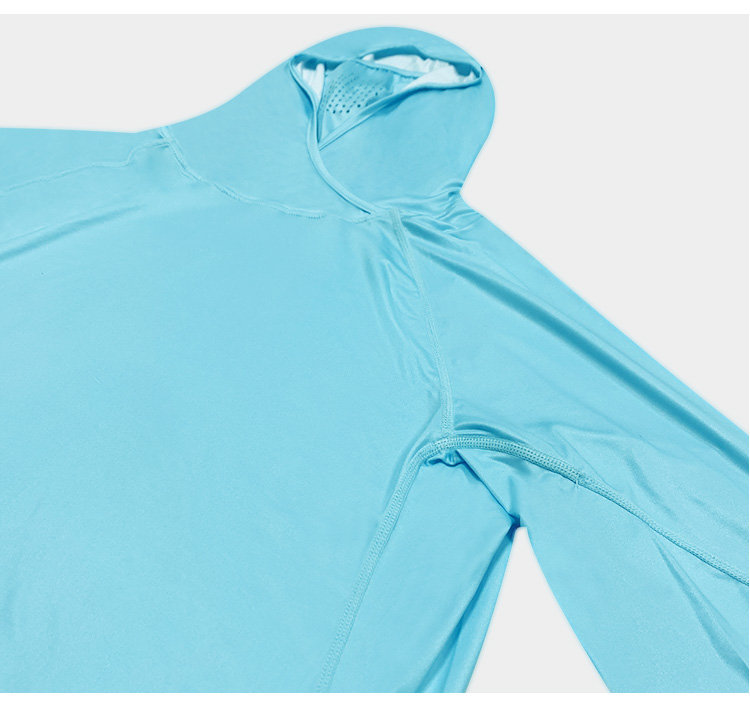
Polyester
Polyester is one of the most widely used materials for Fishing Hoodie Shirts. It has relatively low moisture absorption, dries quickly, and can be engineered into lightweight knitted structures with good air permeability. Polyester fabrics can also be treated or constructed to achieve a high UPF rating.
For hot-weather fishing, a lightweight polyester jersey or performance knit can provide a good balance between breathability, durability, and moisture management. Polyester is also suitable for sublimation printing, making it useful for custom fishing team apparel and branded garments.
Nylon
Nylon offers good abrasion resistance and tensile strength. It is useful when the garment needs to withstand contact with boat equipment, fishing gear, vegetation, or other outdoor surfaces. Nylon blends can be selected when durability and a smooth hand feel are important.
Polyester-Spandex Blends
A small percentage of elastane or spandex can improve stretch and freedom of movement. This is particularly useful for anglers who cast repeatedly, operate fishing equipment, or need a greater range of motion around the shoulders and arms.
However, adding too much stretch fiber can affect fabric recovery, drying characteristics, and cost. The appropriate blend should therefore be determined according to the intended application rather than simply maximizing stretch.
Why Fabric Construction Matters More Than Fiber Type Alone
Two Fishing Hoodies made from 100% polyester can have very different levels of comfort. Fiber composition is only one part of the performance equation. Fabric weight, yarn structure, knitting method, finishing treatment, and garment construction also influence the final result.
For warm-weather fishing, buyers should pay attention to GSM, air permeability, moisture-wicking performance, drying time, and fabric thickness. A lower-GSM fabric is generally lighter, but extremely lightweight material may compromise opacity, abrasion resistance, or durability.
Mesh panels or engineered ventilation zones can increase airflow in areas where heat and moisture tend to accumulate. Flatlock seams can reduce friction against the skin, while a carefully designed hood can provide coverage without creating excessive heat around the head and neck.
UPF Protection and Cooling Performance
One of the most important differences between ordinary hooded shirts and technical fishing garments is UV protection. A Fishing Hooded Shirt designed for outdoor use may incorporate a fabric construction that provides a specified UPF rating.
UPF, or Ultraviolet Protection Factor, measures how effectively a fabric reduces UV radiation reaching the skin. Buyers should request documented test results rather than relying solely on marketing descriptions such as “sun protection.” Fabric color, construction, stretching, moisture, and wear can all influence actual protection.
For commercial products intended for prolonged outdoor exposure, a documented UPF rating such as UPF 30 or UPF 50+ can provide a more meaningful specification than an unspecified “UV-resistant” claim. Compliance requirements and applicable textile testing standards should also be confirmed for the target market.
Fishing Hoodies vs. Traditional Cotton Hoodies
Traditional cotton hoodies can be comfortable in mild conditions, but they are usually not the first choice for high-temperature fishing. Cotton absorbs moisture and can take longer to dry after heavy sweating or accidental splashing.
Technical Fishing Hoodies are generally designed around moisture management and outdoor mobility. Their lighter construction, quick-drying properties, UV protection, and stretch options can make them more suitable for warm-weather fishing.
That does not mean cotton is unsuitable for every fishing application. In cool or dry conditions, a heavier cotton or cotton-blend garment may provide useful comfort and warmth. The correct material depends on climate, activity level, exposure, and required durability.
Key Manufacturing Processes for Fishing Hoodies
Manufacturing quality has a significant influence on garment performance. A typical technical fishing garment starts with yarn selection and fabric knitting, followed by dyeing or printing, finishing, cutting, sewing, inspection, and packaging.
Performance finishing may include moisture-management treatments, UV-related fabric engineering, anti-odor treatments, or other finishing processes depending on the product specification. For printed garments, sublimation is commonly used with polyester because the dye integrates into the fabric rather than forming a heavy surface layer.
During sewing, manufacturers need to control seam strength, stitch density, thread selection, hood attachment, cuff construction, and dimensional stability. Poor seam construction can reduce durability even when the fabric itself has good performance.
Quality control should cover fabric GSM, color consistency, size tolerance, seam strength, print quality, shrinkage, colorfastness, and any claimed functional performance such as UPF or moisture management. For B2B orders, buyers should establish inspection criteria before mass production rather than relying only on finished-product appearance.
Where Are Fishing Hoodies Commonly Used?
A technical Fishing Hoodie can be used across a range of outdoor applications. The exact design should be adapted to the working environment.
Offshore fishing: Lightweight UV-protective fabric can help reduce direct sun exposure during extended periods on boats.
Freshwater fishing: Breathability and quick drying are useful for anglers fishing around lakes, rivers, and reservoirs.
Bass fishing: Lightweight construction and unrestricted shoulder movement are important for repeated casting.
Fly fishing: Stretch and mobility can improve comfort during casting and wading.
Kayak fishing: Lightweight fabric and quick drying are valuable when garments may become wet from spray or splashing.
Fishing tournaments: Custom printing, team colors, logos, and consistent sizing are often important for branded apparel programs.
How to Choose the Right Fishing Hoodie for B2B Orders
Importers, wholesalers, fishing brands, and outdoor retailers should define the intended market before selecting a product specification. A garment designed for tropical offshore fishing may not be appropriate for cold-weather freshwater fishing.
Important purchasing parameters include fabric composition, GSM, UPF rating, breathability, moisture-wicking capability, drying performance, stretch percentage, colorfastness, seam construction, hood design, size range, and available customization methods.
Buyers should also consider the balance between performance and production cost. A very high-specification fabric may not be necessary for an entry-level retail range, while professional fishing apparel may require more advanced fabric engineering and testing.
For custom programs, buyers should confirm the logo method, artwork requirements, color matching, minimum order quantity, sample process, packaging, labeling, and production lead time before placing a bulk order. OEM and ODM manufacturers may also offer different levels of fabric and pattern customization.
Common Problems and Practical Solutions
The hoodie feels hot despite being lightweight
The problem may be caused by low air permeability, excessive fabric density, or poor moisture management. Ask the supplier for fabric specifications and consider a more breathable knit or ventilation panel.
The fabric dries slowly
Check the fiber composition and fabric finishing. Heavy cotton-rich materials generally retain more moisture than lightweight synthetic performance fabrics. A quick-dry test can be included in supplier evaluation.
The hood is uncomfortable in direct sunlight
Hood dimensions, neckline construction, fabric weight, and pattern design all matter. A hood should provide adequate coverage without excessive compression or unnecessary fabric around the face and neck.
The garment loses shape after repeated washing
Dimensional stability depends on fiber, knitting structure, finishing, sewing, and washing conditions. Buyers should request wash-test data and define acceptable shrinkage before mass production.
FAQ About Fishing Hoodies
Are fishing hoodies good for hot weather?
Yes, when they are made from lightweight, breathable, moisture-wicking materials and designed for airflow. A heavy hoodie intended for cold weather will not provide the same level of thermal comfort.
What is the best material for a fishing hoodie?
There is no single best material for every application. Lightweight polyester is a common choice for hot-weather fishing because of its quick-drying and moisture-management properties. Polyester-spandex blends can be considered when stretch and mobility are priorities.
Are Fishing Hooded Shirts suitable for sun protection?
They can be, particularly when the fabric has a tested UPF rating and provides adequate coverage around the arms, neck, and head. Buyers should verify the actual test documentation for any specific UPF claim.
What should B2B buyers ask a Fishing Hoodie manufacturer?
Buyers should ask about fabric composition, GSM, UPF testing, breathability, moisture-wicking performance, colorfastness, shrinkage, size tolerances, customization options, MOQ, sample approval, production capacity, and quality-control procedures.
Can Fishing Hoodies be customized?
Yes. Depending on the manufacturing process and fabric, customization can include colors, patterns, sublimation printing, logos, labels, hood construction, cuffs, sizing, and packaging. OEM and ODM options should be confirmed with the manufacturer before development.
Conclusion
A Fishing Hoodie can help anglers stay more comfortable in hot conditions by combining sun protection, moisture management, breathability, and lightweight construction. Its ability to keep the wearer cool depends less on the word “hoodie” itself and more on the engineering of the fabric and garment.
For B2B buyers, the most useful approach is to evaluate the complete specification: fiber composition, GSM, air permeability, moisture-wicking performance, UPF rating, stretch, construction quality, testing, and intended fishing environment. Selecting these parameters correctly can produce a Fishing Hoodie that provides practical performance for professional anglers while also meeting the durability, customization, and quality requirements of international wholesale and private-label markets.