





The performance of Fishing Wear depends largely on the materials used in its construction.While design and fit are important,fabric selection ultimately determines comfort,durability,and functionality in real fishing environments.High-performance Fishing Wear is engineered to withstand water exposure,UV radiation,heat,wind,and constant movement,making material choice a critical factor for both manufacturers and buyers.
Synthetic fibers are the foundation of most modern Fishing Wear due to their versatility and performance advantages.Polyester is one of the most widely used materials in Fishing Wear because it is lightweight,durable,and resistant to water absorption.Unlike cotton,which becomes heavy and slow-drying when wet,polyester dries quickly and maintains its shape during extended use.This makes it ideal for Fishing Shirts,pants,and base layers designed for long hours on the water.
Nylon is another popular material in high-performance Fishing Wear,especially in garments that require higher abrasion resistance.Nylon fibers are stronger and more elastic than polyester,making them suitable for Fishing Wear used in rugged environments such as rock fishing or offshore applications.Nylon-based Fishing Wear often feels smoother against the skin and offers excellent wind resistance,which is valuable in open-water conditions.
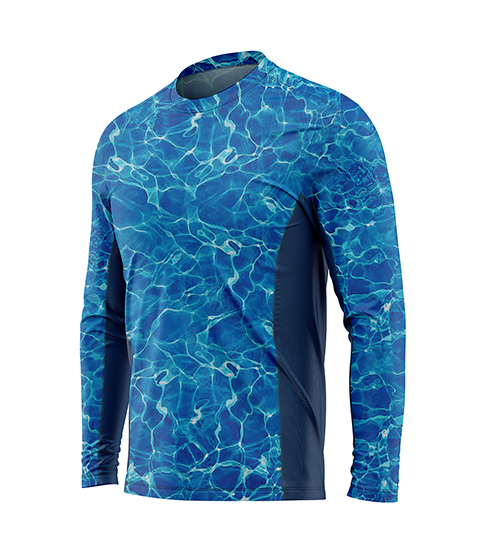
For advanced functionality,many Fishing Wear manufacturers use blended fabrics that combine polyester or nylon with spandex or elastane.These blends add stretch and flexibility,allowing anglers to move freely when casting,reeling,or handling equipment.Stretch-enhanced Fishing Wear improves comfort without compromising durability,making it a preferred choice for professional anglers and fishing guides.
Another key material consideration in Fishing Wear is UV-resistant fabric technology.Some high-performance fabrics are engineered with tight weaves or treated with UV-blocking agents that enhance sun protection.These materials are tested to achieve specific UPF ratings,ensuring consistent protection throughout the garment’s lifespan.UV-resistant Fishing Wear materials are especially important for markets where fishing activities take place under intense sunlight.
Breathability is also closely tied to material selection.Advanced Fishing Wear fabrics are designed to allow air circulation while still providing protection from external elements.Mesh panels and moisture-wicking yarns are often incorporated into Fishing Wear to improve ventilation and reduce heat buildup.This balance between protection and airflow is essential for comfort in hot and humid climates.
In waterproof Fishing Wear,material selection becomes even more technical.High-performance waterproof fabrics often use multi-layer constructions,including an outer protective layer,a waterproof membrane,and an inner lining for comfort.These materials prevent water penetration while allowing sweat vapor to escape,maintaining dryness without overheating.The durability of these layers determines how well Fishing Wear performs over time,especially after repeated washing and exposure to saltwater.
Sustainability is an emerging factor in Fishing Wear material selection.Many fishing brands are now exploring recycled polyester and eco-friendly coatings to reduce environmental impact.These materials offer similar performance characteristics to traditional synthetics while appealing to environmentally conscious consumers.Sustainable Fishing Wear materials are becoming a competitive advantage in global markets where buyers increasingly value responsible manufacturing.
From a manufacturing and sourcing perspective,material consistency and quality control are crucial.High-performance Fishing Wear requires fabrics that perform reliably under real-world conditions.This is why reputable Fishing Wear manufacturers invest heavily in material testing,including colorfastness,tear strength,UV resistance,and moisture management.
Ultimately,the best materials for Fishing Wear are those that align with the intended use.Lightweight polyester blends may be ideal for casual summer fishing,while reinforced nylon fabrics suit demanding offshore or cold-weather applications.By selecting the right materials,Fishing Wear delivers long-term comfort,safety,and performance.
As fishing continues to grow as both a recreational and professional activity,material innovation will play a central role in the evolution of Fishing Wear.Buyers who understand fabric performance are better equipped to choose products that meet their needs,while brands that prioritize high-quality materials position themselves for long-term success in the global fishing apparel market.