





Spending long hours fishing under intense sunlight is not just uncomfortable—it can be harmful.For anglers who fish in tropical regions,offshore waters,deserts,or high-altitude lakes,sun exposure becomes a serious concern.This is why SPF Fishing Shirts for men have become essential gear rather than optional apparel.But a common question from buyers and distributors alike is whether these shirts truly protect in extreme sun conditions.
To answer that,it’s important to understand how modern SPF Fishing Shirts are designed and tested.
Unlike ordinary long-sleeve shirts,SPF Fishing Shirts for men are engineered specifically to block ultraviolet radiation.Most high-quality products rely on UPF-rated fabrics rather than chemical coatings.UPF(Ultraviolet Protection Factor)measures how much UV radiation can penetrate the fabric.A UPF 50+Fishing Shirt blocks more than 98%of harmful UVA and UVB rays,making it suitable for harsh sun exposure found in equatorial regions or open-sea fishing environments.
Extreme sun conditions typically involve three factors:prolonged exposure,reflective surfaces such as water,and high ambient temperatures.In these situations,fabric density,fiber type,and garment construction all play a crucial role.The best SPF fishing shirts for men are usually made from tightly woven polyester or nylon blends.These synthetic fibers naturally resist UV penetration better than cotton,which becomes less effective when stretched or wet.
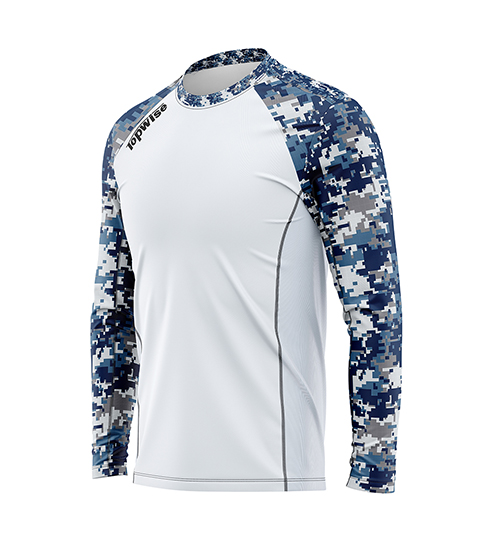
Another important factor is coverage.Shirts designed for extreme sun often include extended sleeves,high collars,and sometimes integrated hoods.This minimizes direct exposure to sensitive areas such as the neck and forearms,which are common sites for sunburn during fishing trips.Many lightweight SPF fishing shirts for men now achieve this full coverage without sacrificing comfort,thanks to advanced knitting techniques that balance breathability with protection.
Heat management is just as important as UV blocking in extreme conditions.A shirt that protects from the sun but traps heat will quickly become unwearable.This is why moisture-wicking and ventilation features are standard in performance-grade fishing shirts.Mesh panels,laser-cut vents,and quick-dry yarns help regulate body temperature even under intense sunlight.In real-world use,anglers often report that a well-designed SPF fishing shirt feels cooler than bare skin exposed to direct sun.
Color also plays a role,though it’s often misunderstood.Dark colors generally absorb more UV radiation,but modern fabric treatments allow light-colored shirts to achieve high UPF ratings as well.This is especially relevant for buyers who prefer lighter tones for heat reflection while still demanding strong sun protection.
For commercial buyers and brands sourcing products globally,testing and certification are critical.A reliable SPF fishing shirts for men manufacturer will provide third-party lab test reports confirming UPF ratings under standardized conditions.This is particularly important for markets like Australia,the United States,and Europe,where consumers are increasingly educated about sun safety and expect verifiable performance claims.
Customization is another growing trend,especially for brands targeting specific climates or professional fishing communities.Custom SPF fishing shirts for men can be tailored with region-specific features such as extra ventilation for tropical climates or reinforced panels for saltwater environments.Logos,colorways,and fabric weights can all be adapted without compromising UV protection when handled by an experienced manufacturer.
In extreme sun conditions,durability also matters.Repeated exposure to saltwater,sweat,and intense UV radiation can degrade low-quality fabrics over time.Premium fishing shirts maintain their protective properties after dozens of wash cycles,ensuring long-term value for end users and fewer complaints for distributors.
So,do SPF fishing shirts for men protect in extreme sun conditions?When properly designed,tested,and sourced,the answer is yes.High-UPF fabrics,full-coverage designs,breathable construction,and manufacturing quality all combine to create a garment capable of protecting anglers in some of the harshest environments on earth.Choosing the right supplier and understanding fabric performance is key to ensuring that protection is not just promised—but delivered.