





Reinforced seams are designed to prevent tearing in fight kit MMA BJJ Shorts by distributing pulling forces, securing fabric panel connections, and strengthening areas exposed to repeated movement. During MMA and Brazilian Jiu-Jitsu training, the crotch, waistband, inseams, and side-slit openings experience considerable tension. If these areas are poorly constructed, stitching may break or the fabric may begin to separate even when the main material is relatively strong.
A durable seam requires more than adding extra rows of stitches. Manufacturers must select a suitable stitch type, thread, seam allowance, stitch density, and reinforcement method according to the fabric and garment design. The objective is to create a connection that remains secure while allowing the shorts to move naturally with the athlete.
How Are Reinforced Seams Constructed in MMA Bjj Shorts?
Reinforced seams are created by combining appropriate sewing structures with additional support at high-stress points. The construction method depends on whether the shorts use woven polyester, stretch woven fabric, or knitted compression material.
Double-Stitch and Multi-Row Stitching
Double stitching uses two parallel rows of stitches to secure a seam. It can provide additional support compared with a single stitch line, particularly in areas exposed to repeated pulling. Multi-row stitching may also be used around the waistband, seat, and other important garment connections.
However, adding more stitch rows does not automatically produce a stronger seam. If the needle, thread, stitch tension, or fabric structure is unsuitable, excessive stitching can create perforation points or reduce flexibility. Manufacturers must balance seam strength with the ability of the material to stretch during movement.
For traditional MMA Fighting Shorts, double-stitched construction can be used in selected structural areas. The actual stitch arrangement should be determined through sample testing rather than applied identically to every section of the garment.
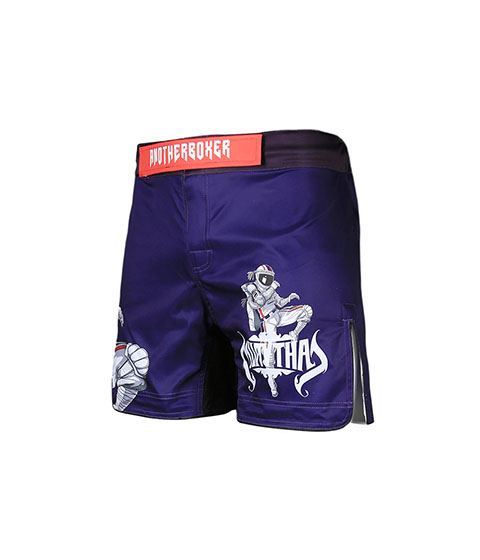
Overlock Stitching for Clean and Secure Edges
Overlock stitching wraps thread around the fabric edge to prevent fraying and secure joined panels. It is commonly used in sportswear manufacturing because it can create an efficient seam while controlling loose fabric edges.
In MMA Shorts, overlock construction may be used along internal panel joins and selected edges. For areas exposed to stronger pulling forces, an overlock seam may be combined with another stitch line or a suitable reinforcement method.
Thread tension is especially important. Excessive tension can cause the seam to pucker or become less flexible, while insufficient tension may leave loose loops and an unstable edge. During production, sewing operators should check stitch formation and adjust machine settings according to the fabric thickness and elasticity.
Bartack Reinforcement at Stress Points
A bartack is a short, dense group of stitches used to reinforce a specific point. It is particularly useful where a seam terminates or where several garment components connect. On fight shorts, bartacks may be positioned at the ends of side slits, waistband attachment points, and selected pocket-free closure or fastening structures.
Side slits are important for mobility, but their upper endpoints can become stress concentration areas. During high kicks and deep hip movements, the fabric around the slit opening is repeatedly pulled. A correctly positioned bartack helps secure this endpoint and reduces the likelihood of the opening extending into the main body fabric.
The reinforcement must be strong enough to secure the area without creating an excessively stiff or uncomfortable patch. Its stitch length, width, thread, and position should be specified in the production sample.
Why Are Certain Areas of MMA Shorts More Likely to Tear?
The risk of seam failure is not evenly distributed across a garment. Different sections experience different forces depending on the athlete's movement and the pattern design.
Crotch and Gusset Connections
The crotch is one of the most important structural areas in MMA grappling shorts. High kicks, sprawls, guard movements, and wide leg positions repeatedly stretch the fabric around this section. A poorly shaped crotch seam can concentrate tension in a small area, increasing the risk of thread breakage or fabric tearing.
A gusset adds a shaped fabric panel between the legs to improve movement and distribute tension across a wider area. Depending on the design, the gusset may use a stretch-compatible textile and carefully positioned seams. This approach can reduce excessive pulling at a single junction.
Manufacturers should inspect the gusset dimensions, panel alignment, seam allowance, and stitch quality. A gusset that is too small or incorrectly positioned may fail to provide the intended movement benefit.
Waistband Attachment and Closure Areas
The waistband must remain secure while the athlete changes position, bends, and grapples. Repeated tension can affect the connection between the waistband and the main body panels. If the attachment is weak, the stitching may open or the fabric may distort.
Reinforcement can include additional stitch rows, secure seam construction, and bartacks at selected attachment points. For designs using elastic, hook-and-loop fastening, or an internal drawcord, the attachment method must be compatible with the closure system.
Quality inspection should check waistband tension, stitching consistency, fastening security, and whether the waistband remains flat after repeated extension and washing. A strong attachment should not create excessive bulk or discomfort around the waist.
Side Slits and Inseams
Side slits allow the legs to move more freely during striking and grappling. However, the slit endpoints and folded edges can experience repeated tension. If the slit is cut too deeply, finished poorly, or left without suitable reinforcement, a small opening may gradually develop into a larger tear.
Manufacturers can strengthen slit endpoints with bartacks or other controlled reinforcement. The edge should also be finished neatly to prevent fraying. Inseams require similar attention because they connect panels that move against each other during walking, kicking, and ground work.
How Do Manufacturers Choose the Right Thread and Stitch Density?
Thread selection affects seam strength, flexibility, abrasion resistance, and sewing performance. A thread that is too weak may break under tension, while an overly rigid thread may not work well with a highly elastic fabric.
Polyester sewing thread is commonly used in sportswear because it offers useful strength, abrasion resistance, and colour options. The appropriate thread size depends on fabric weight, seam construction, needle size, and the required appearance.
Stitch density must also be controlled. Too few stitches may leave the seam insufficiently secured, while too many stitches can create a perforated line that weakens the fabric between needle penetrations. This is particularly important for lightweight woven materials and stretch fabrics.
During sample development, manufacturers should test different thread and machine settings on the actual production fabric. The approved combination should then be recorded so that bulk production maintains consistent seam quality.
Can Reinforced Seams Prevent Tearing Without Restricting Movement?
Yes, when the reinforcement method is matched to the fabric and the location of the seam. The main challenge is balancing structural support with flexibility. MMA shorts must remain secure during sudden movements without creating rigid areas that interfere with hip rotation or leg extension.
For example, a heavy reinforcement patch at the crotch may increase local strength but create discomfort during deep squats or grappling transitions. A more suitable approach may combine a correctly shaped gusset, stretch-compatible stitching, and targeted reinforcement at the points that experience the greatest tension.
Flatlock stitching can be useful in selected stretch garments because it creates a relatively low-profile seam that may reduce rubbing against the skin. However, flatlock construction is not automatically the strongest option for every structural connection. Manufacturers should select the seam type according to whether the priority is low bulk, stretch, edge control, or load resistance.
Finished samples should be tested through repeated kicking, squatting, sprawling, and grappling movements. Inspectors should look for seam opening, broken thread, fabric distortion, and uncomfortable pressure points. This helps confirm that reinforcement improves durability without compromising performance.
What Quality Tests Can Identify Weak Seams Before Shipment?
Seam inspection should begin during sample development and continue throughout bulk production. Visual checks can identify obvious sewing defects, while laboratory tests provide more objective information about seam performance.
Seam Strength and Seam Slippage Testing
Seam strength testing measures the force required to break a sewn connection under specified test conditions. ISO 13935 test methods are commonly used to evaluate the maximum force to seam rupture in textile assemblies. For woven garments, seam slippage testing can also help determine whether yarns move apart beside the stitch line before the thread or seam actually breaks.
These results are useful when comparing different sewing constructions, but buyers should confirm that the selected method is suitable for the fabric and seam geometry. A straight laboratory seam specimen does not necessarily reproduce the performance of a curved crotch seam in a finished garment.
For a more practical assessment, manufacturers can prepare test specimens using the actual production fabric, thread, and stitch settings. The test report should identify the method, specimen direction, seam type, and measured result.
Stretch and Repeated Movement Inspection
For stretch MMA shorts, seams should be checked under extension as well as during a static pull test. The fabric may stretch considerably while the stitching remains comparatively rigid. If the seam cannot accommodate the fabric's extension, stitches may break or the fabric may gather around the join.
A controlled stretch inspection can reveal whether the seam opens, loses shape, or restricts movement. Manufacturers should evaluate both lengthwise and crosswise extension when the garment uses four-way stretch material.
Wash Testing and Finished Garment Inspection
Repeated washing can expose problems that are not visible in a new sample. Shrinkage, fabric growth, thread damage, and changes in seam appearance may affect the fit and durability of the finished shorts.
Before bulk approval, buyers should request wash trials using agreed washing and drying conditions. After testing, inspectors should examine the crotch, waistband, side slits, inseams, and hem for loose threads, broken stitches, puckering, and seam opening.
Quality teams should also check multiple sizes. Changes in pattern dimensions can affect fabric tension and seam loading, so a construction that works well in one size may need further evaluation in larger or smaller sizes.
How Should B2B Buyers Specify Reinforced Seams in Custom MMA Shorts?
For OEM and private label projects, buyers should describe reinforcement requirements in a technical specification rather than relying on general terms such as heavy-duty stitching or premium construction.
A useful specification should identify the fabric composition and weight, seam locations, stitch types, thread requirements, reinforcement positions, and approved sample measurements. Buyers can also request close-up photographs of the crotch gusset, waistband attachment, side-slit endpoints, and internal seams during sample approval.
For example, a custom MMA shorts project may require double-row stitching at selected structural seams, bartack reinforcement at side-slit endpoints, and a stretch-compatible construction around the gusset. The exact arrangement should be confirmed through prototype testing and adjusted according to the fabric used.
Buyers should also establish acceptable inspection criteria with the supplier. These may include no skipped stitches, no exposed loose thread ends, consistent stitch tension, secure seam endpoints, and no visible seam opening after agreed testing.
What Should Buyers Look for in an MMA Shorts Manufacturer?
A capable MMA shorts manufacturer should understand how pattern design, fabric behaviour, and sewing construction work together. Experience with ordinary sportswear does not always guarantee suitable construction for garments exposed to repeated grappling and pulling forces.
When evaluating suppliers, buyers should ask whether the factory can develop gusset structures, reinforce side slits, select suitable thread and stitch types, and carry out sample inspections. It is also useful to review the factory's sewing equipment, production quality-control process, and experience with sublimation or other decoration methods.
For repeat orders, the supplier should retain the approved sample and technical specifications. This helps control changes in fabric, stitch settings, and garment measurements between production batches. Consistent construction is especially important for wholesalers and brands selling the same MMA training shorts across different markets.
Conclusion
Reinforced seams prevent tearing in fight kit MMA BJJ shorts by strengthening high-stress connections and distributing tension across the garment. Double stitching, overlock construction, bartack reinforcement, and gusset design all have different functions. The correct combination depends on the fabric, garment pattern, and intended training use.
For overseas B2B buyers, seam durability should be evaluated through both laboratory testing and finished-garment trials. Checking seam strength, stretch performance, washing stability, and critical stress points before bulk production helps reduce quality risks and improve product consistency. A well-designed seam works together with the fabric and pattern to produce MMA shorts that can withstand demanding training conditions.